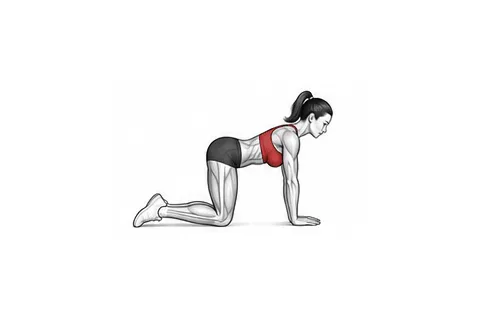
The bird dog is a hands-and-knees exercise in which an arm and the opposite leg reach away from the body while the trunk stays controlled. The useful question is not how high you can lift. It is whether you can manage the reach and return without turning the movement into a roll through the hips or a sag through the back.
Open the DailyHomeFit bird dog demonstration alongside this guide. The page includes a simpler option that moves one limb at a time. This is general adult fitness information, not an individual technique assessment or a treatment for back pain. If a health condition, injury or recent surgery affects your choices, obtain suitable individual guidance. Stop if the movement causes pain, dizziness or makes you feel unwell.
Set up the supporting position
The American Council on Exercise bird dog guide places the hands beneath the shoulders and knees beneath the hips, with the abdominal muscles engaged and the spine held without excessive arching or sagging. Its key cue is to limit the limb lift to a height at which the lower-back position remains controlled. It also advises keeping the hips and shoulders level rather than rotating them during the reach.
Review that setup before adding a moving limb. A mat is listed on DailyHomeFit, but having one does not establish whether kneeling or supporting weight through your hands is comfortable for you. If you cannot settle into the starting position comfortably, do not force the reach to get past the setup.
Place your screen where you can read between attempts. Turning your head repeatedly to watch a moving demonstration makes it harder to concentrate on the position you are trying to understand.
Read the movement as three separate moments
- Start: identify the supporting hands and knees before anything moves.
- Reach: follow one arm and the opposite leg; do not make height the goal.
- Return: bring those limbs back with control before considering the other side.
Separating the sequence this way is a viewing strategy, not a prescription for a hold time. Pause the animation and reread a cue if you lose track of the opposite-side pairing. A loop can make a movement look continuous, but your own attempt can include a pause to reset.
Use one moving limb when coordination is the obstacle
DailyHomeFit's easier option is to move one arm or one leg at a time. That lets you review a smaller part of the sequence instead of immediately coordinating both. It is an option to compare, not a requirement to complete a fixed number of attempts before trying the main version.
Notice whether the difficulty is understanding the sequence or finding a comfortable position. Those are different problems. Rewatching may clarify which limbs move together, but a demonstration cannot explain discomfort or determine which alternative is appropriate for you. A qualified exercise professional can observe an attempt and offer individual feedback.
Three common mix-ups to avoid
- Mistaking a higher lift for better control. Revisit the supporting position rather than continuing to lift when the trunk changes position.
- Counting a quick return as a reset. Give the return attention; it is the transition into the next attempt, not an unimportant gap between reaches.
- Treating a mirror image as the instruction. If following the character's left and right feels confusing, use the written opposite-arm-and-leg cue rather than trying to imitate its screen direction.
These prompts help you interpret the exercise. They do not prove that your form is correct or establish a safe workload. ACE describes the movement as a way to practise trunk stability during limb motion, not a contest to reach the farthest point.
Check the rest of the workout before starting
Gentle core, steady start combines marching, bird dog, dead bug and bridge. Bird dog uses hands-and-knees support; dead bug and bridge use lying positions. Review those transitions and all the movement instructions rather than selecting the session on the bird dog card alone.
Build your core control also includes bird dog, but pairs it with marching, dead bug and plank and is labeled intermediate. A shared movement does not make two complete sessions equivalent. The interval timer also does not assign a repetition count or assess technique.
For comparison with a lying opposite-limb movement, read Dead Bug at Home. The practical difference is the supporting position and sequence you need to understand, not a claim that one exercise is universally better. Choose a movement you can review clearly, then consider a complete workout separately.
Source checked on 19 October 2026: ACE's bird dog exercise guide for setup, trunk control and level hips and shoulders. Product details were checked against DailyHomeFit's published exercise and workout records. This article does not claim professional review, firsthand testing or endorsement by ACE.