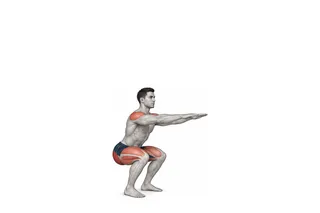
Bodyweight exercises use your own body as resistance. For beginners, choosing a suitable position and learning the movement matter more than collecting a long list of exercises. This guide compares five movements already in the DailyHomeFit library, with links to their demonstrations and easier options.
These examples are a movement menu, not a prescribed circuit or a complete training programme. You do not need to perform all five. Read the equipment notes, check that you have enough space, and choose a level you can control.
Compare standing and floor options
A standing exercise may be convenient when floor space is limited. A floor exercise requires room to get down and up, and some movements need a mat. Beginner describes the library category; it does not guarantee that an exercise will suit every person.
- Wall push-up: a standing pushing movement supported by a solid wall. The guide explains positioning and common form mistakes.
- Bodyweight squat: a standing leg movement. Explore the smaller-range option before trying to move deeper.
- Glute bridge: a lying movement. Use the demonstration to understand the lift and the easier option.
- Bird dog: a hands-and-knees movement focused on trunk control. Try one limb at a time if reaching opposite limbs together is difficult.
- Dead bug: a lying core movement. Compare its position and instructions with bird dog rather than assuming they feel the same.
Learn one movement before adding another
Open an exercise page and read its instructions before following the animation. Notice where the hands and feet begin, which body parts move, and what should remain steady. A GIF can demonstrate a sequence, but cannot check your form or tell whether a position is comfortable for you.
Practise slowly and keep breathing. If you cannot stay controlled, use the easier option, reduce the movement or choose a different exercise. Feeling rushed is a reason to pause and review the instructions, not to speed up to match an animation.
Choose a published session when you are ready
Use the workout directory to compare duration, equipment and movement lists. Chest foundations includes wall and knee push-ups. The Gentle core session uses floor-based movements. Read every movement in a session before starting its timer.
The library and directory serve different purposes: the library helps you learn individual movements, while the directory provides the sessions currently published. Choosing several exercises from this article does not automatically create a balanced workout or a personalized plan.
Progress and recovery
The NHS advises building strength exercise gradually. Progress might mean better control, becoming comfortable with a movement, or returning to a manageable session. It does not require adding repetitions or choosing a harder version every day.
Leave room for recovery. Stop if a movement causes pain. If an injury, health condition, pregnancy or another concern affects your choice, ask an appropriate healthcare professional for individual advice. These demonstrations provide general adult fitness information.
Questions beginners often ask
Do bodyweight exercises need equipment? Many use no weights, but a wall movement needs a stable wall and floor positions may be more comfortable on a mat. Always check the exercise page rather than relying on the article title.
Should I do all five exercises? No. They illustrate different positions and movement patterns. Start by learning an option that suits you; this list is not a required daily routine.
What should I read next? Use the equipment-free workout guide for practical session-selection advice, or the getting-started guide for planning and tracking your routine.
Source: NHS strength exercises. Movement links refer to DailyHomeFit’s own demonstrations. General fitness information; no professional-review claim.