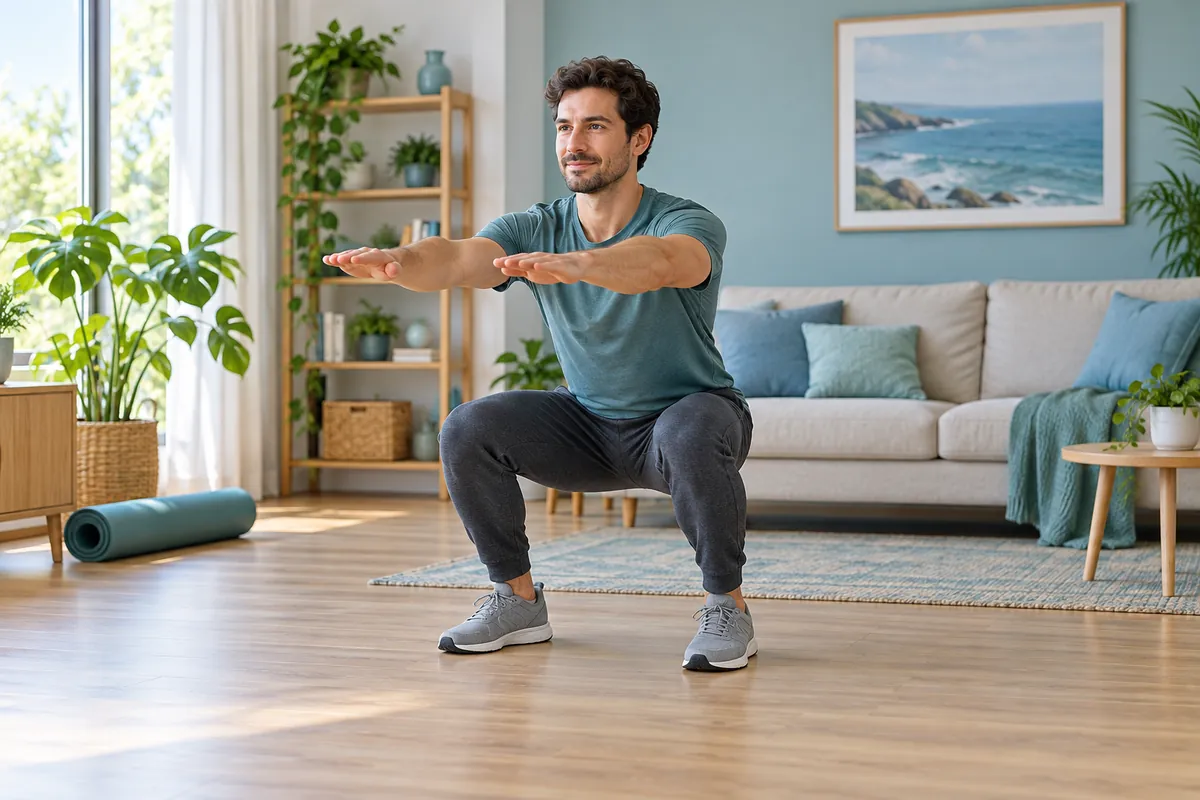
This beginner calisthenics workout plan starts with wall push-ups and squats, then offers a choice between repeating a standing session and reviewing floor exercises. The two-week calendar below separates learning days from practice, with time between sessions to reconsider the next step.
This two-week example is a learning schedule built around existing DailyHomeFit sessions. It is not a complete strength programme or an individual prescription. Adapt or stop the schedule when a movement or session does not suit you.
Choose a standing or floor setup
The no-equipment starter repeats marching, squats, wall push-ups and marching. It needs a clear floor and a solid wall even though it does not require hand weights. The full-body reset also includes bird dog and bridge, so it needs space for floor transitions and a mat.
Compare those positions before selecting a session. Standing is not automatically easy, and a floor option is not automatically a progression. The routines do not include a pulling exercise such as a row; do not treat either as comprehensive training for every major muscle group.
Week one: learn before adding more
- Monday: review wall push-up and squat, including their easier options. Prepare the space. You can use this as a learning day without completing a timed session.
- Thursday: if the movements and setup are suitable, try the no-equipment starter at a manageable pace. Pause when needed. The programmed intervals are not a requirement to keep moving despite discomfort.
- Other days: leave room for recovery and your usual appropriate activity. A calendar gap is not a demand to remain inactive or to add another hard session.
The dates are examples, not deadlines. If you need longer to understand the instructions, repeat the learning step instead of moving on to stay on schedule.
Week two: repeat or compare one alternative
- Monday: return to the standing session if it remains suitable. Note whether the space, instructions and transitions are easier to organise.
- Thursday: either repeat that session or inspect the floor-based alternative. Read bird dog and bridge first. Comparing a routine does not oblige you to perform it.
- Between these sessions: review how manageable the previous choice was before selecting another workout.
The NHS strength and flexibility guide describes general adult strengthening guidance of at least two days a week. This example’s learning days do not automatically meet that guidance; reviewing a page is different from strengthening activity.
Change one practical factor at a time
Progress can begin with knowing the start position, using a comfortable range or taking an unhurried transition. Do not increase speed, repetitions and movement difficulty together merely because a week has passed. The website timer does not assess readiness.
Avoid improvising pulling exercises from a door, table or unstable furniture to fill the programme’s gap. Ask a qualified instructor about a more complete plan and suitable equipment if that is your next goal. This introductory schedule does not prepare you for advanced calisthenics skills.
Keep a short, accurate record
Record the session you opened, the option you actually used and any pauses. “Reviewed the floor routine” and “completed the standing routine” are different entries. A completion mark does not measure strength gains, calories or whether every interval was moderate aerobic exercise.
For more starting movements, use the beginner bodyweight guide. Stop for pain, dizziness or feeling unwell. Get individual advice if a health condition, injury or uncertainty about exercise affects your choice.
Prepared by the DailyHomeFit editorial team. General adult fitness education. NHS source checked 29 October 2026; no professional assessment or guaranteed outcome is claimed.
Put the plan beside the session
Keep the two-week plan page open when comparing available sessions. Read the warm-up guide before the timer and the talk-test explanation when interpreting aerobic effort. Learning a movement and measuring effort are different tasks.
Calisthenics for homeowners and renters: prepare the room
Home calisthenics does not require a dedicated fitness room. Whether you own or rent, the useful questions are whether the floor is clear, the wall is solid and you can move without hitting furniture. Leave doors, radiators and movable furniture out of your support setup.
Before the first session, walk through the transitions without the timer. Can you move from the wall to your standing position without stepping over a mat? If you choose the floor session, can you get down and up comfortably? Keep the mat where it will not slide, and set the screen somewhere visible without turning your neck during a movement.
The three clips above show wall push-ups, squats and bird dog. They are playable loops converted from DailyHomeFit's existing animations, not a real-time class or a prescribed repetition speed. Pause the clip, read the instructions and practise the easier option before deciding whether to include it. For a focused upper-body comparison, see arm exercises with wall and floor support.



 Pedal Resistance Trainer
 Figure-8 Resistance Band
 Foam-Grip Push-Up Bars
 Dual-Wheel Ab Roller with Knee Mat
 Adjustable Jump Rope
 Adjustable Hand Gripper
 6 mm Exercise Mat
 Fabric Resistance Loop Set
 Yoga Stretching Strap
 EVA Foam Yoga Block